
Why Pride still matters
On Wednesday, a man called me a "queer cunt" and threatened to tie a dog lead around my neck – a reminder, if it were needed, that homophobia is alive and kicking in 2026.

As we all know, June is Pride Month. We know this because Big Tesco is stocking rainbow coloured Pride merch and social media is awash with people asking “When’s Straight Pride?”
To the best of my knowledge, nobody has ever been criminalised or persecuted simply for being straight. No country in the world outlaws heterosexual marriage or executes its citizens for the crime of being straight. Nobody grows up being physically bullied or publicly shamed for being heterosexual.
So until someone offers a more compelling argument than those I’ve seen on social media, I can’t see any need for Straight Pride.
Meanwhile, the need for Not Straight Pride is still very strong. I was reminded of this on Wednesday afternoon. The previous evening, my friend Sam and I watched the final episode of the Russell T. Davies drama Tip Toe, in which a gay man my age is lynched and hung from a lamppost.
On Wednesday, I took Sam’s adorable dachshund Darcy for a walk near her house in Islington, where a man shouted at me – “Let that dog off the lead or I’ll put a lead around your neck, you queer cunt!”
It’s been some time since I was subjected to this kind of abuse. I laughed it off and continued on my way. But nobody should have to put up with this.
The feelings of anger, fear, shock and even shame hung over me all day. These are feelings many people in the LGBTQ+ community know only too well. This is why we have Pride.
I attended my first Gay Pride in London in 1985, long before it was rebranded as LGBTQ+ Pride and the corporate sponsors and rainbow flags took over.
Back then, Pride flags were emblazoned with pink triangles rather than rainbows and celebrations lasted a few days at most. The turn-out was far smaller and the event had more of a grass-roots, community feel. These days, I feel more at home at my local Pride event in Hastings than I do at London Pride – or ‘Pride in London’ as it’s now known.
But you never forget your first Pride, and I’ve never forgotten mine. I wrote about it at length in my memoir – an extract from which you’ll find below.
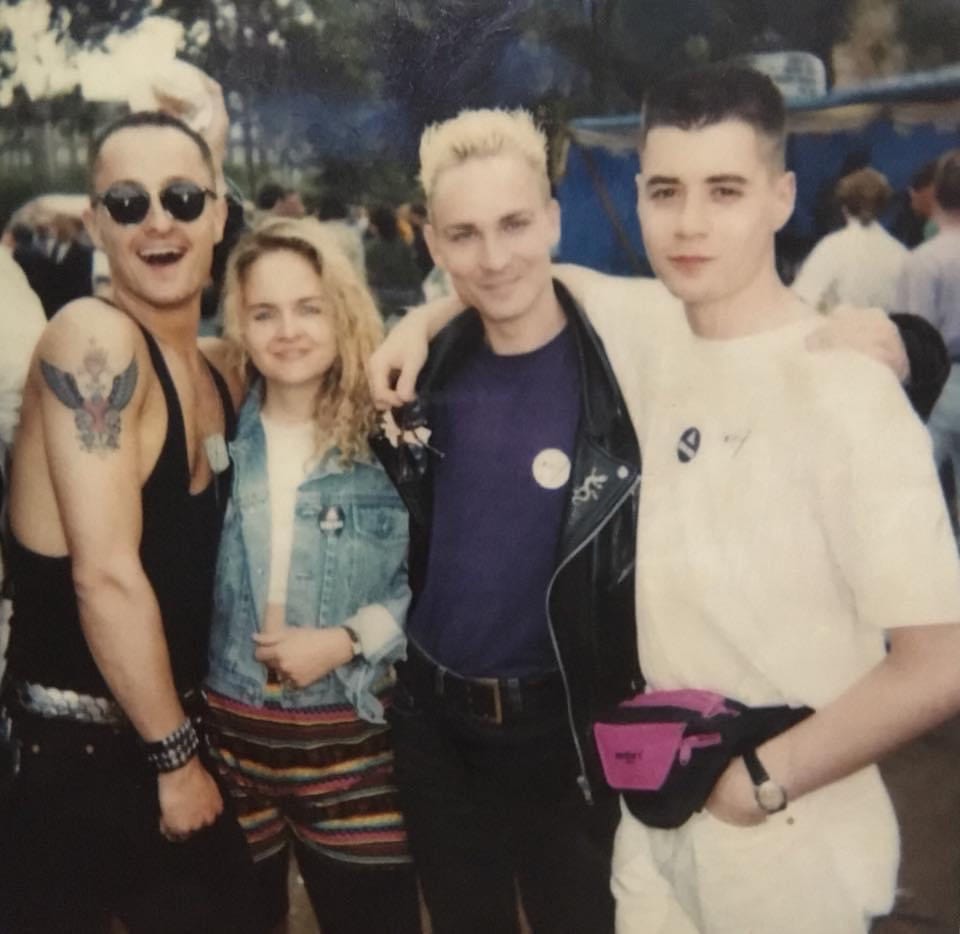
I don’t have any photos of that day, but I do have an old Polaroid which was taken at London Pride some five years later – by which time I’d marched against Clause 28, joined the AIDS activist group ACT-UP, lost the first of far too many friends and acquired the first of a growing number of tattoos.
Looking back, the impulse to permanently mark my skin was symptomatic of the sense of loss and impermanence which shaped my daily life.
People often asked me, “Aren’t you worried that you might regret it when you’re older?” I’d smile politely and bite my tongue. I didn’t expect to grow older.
My first tattoo hurt like hell. It also became infected and required treatment with a course of antibiotics. But I was ridiculously pleased with it. Can you tell?
Anyway, back to Pride. I first came out in February 1985, to a fellow student named Tracey Hope. It was half term and we were visiting my family in South Wales. My parents kept referring to Tracey as my girlfriend and I kept correcting them.
I didn’t tell my parents I was gay and wouldn’t do so for another four years. But I told Tracey, and that short conversation was life changing. It felt as if an enormous weight had been lifted.
Returning to college, I came out to my personal tutor and took myself off to Heaven for the first time. I made a few gay friends at college and a few more out on the scene. But my gay friendship circle was small, and none of us were particularly political.
Until that summer, when I finally plucked up the courage to go to Pride…
Chapter 7 - Pride (In The Name of Love)
I attended my first Gay Pride march in June 1985. It was the Pride featured in the 2014 film of the same name, with the Welsh miners and the marching band. Having recently fled Wales and everything it represented to me, I confess I didn’t appreciate the significance of this at the time. But, as the film demonstrates, the groundbreaking work of Lesbians and Gays Support the Miners was instrumental in garnering the support of the National Union of Mineworkers, who would later pressurise the Labour Party into incorporating lesbian and gay rights as part of the party programme. The miners helped pave the way for the equality measures introduced over a decade later under Tony Blair’s government.
Not featured in the film, but certainly present on the day, was Divine – the larger-than-life drag queen who starred in trashy films by John Waters, which were often shown at the Scala cinema in King’s Cross, and who was enjoying a second career as a disco diva, bellowing songs like ‘Native Love’, ‘Shoot Your Shot’ and his 1984 hit ‘You Think You’re A Man’. When Divine performed the single on Top Of The Pops, there were a record number of complaints. But the gay scene welcomed him with open arms.
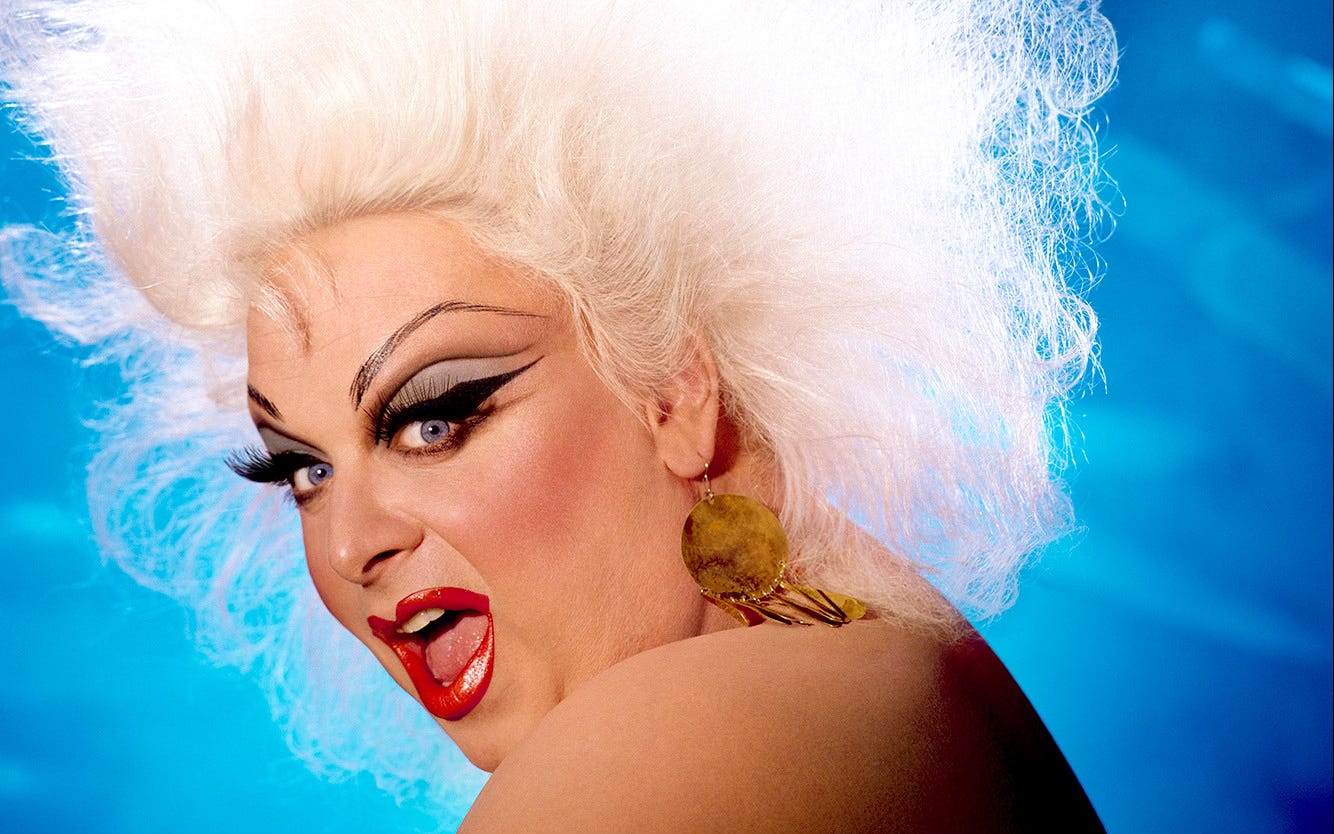
Divine had already appeared at Heaven. Now the club invited him to be their guest performer for Pride. But, due to licensing restrictions, he wouldn’t be performing on the back of a float or on a sound stage in the park. No, he’d be standing on the roof of a hired pleasure boat as it sailed slowly along the Thames.
The 1985 Lesbian and Gay Pride march began in Hyde Park and ended in Jubilee Gardens, where there were food and drink stalls, live entertainment and political speeches. It’s quite possible that some people missed Divine’s performance. But for those who didn’t, it was pretty memorable.
Dressed in a body-hugging silver-blue gown, gyrating to the beat in his usual outrageous fashion, he screamed along to ‘You Think You’re A Man’ as the backing track boomed from makeshift speakers. If you ask me, he knocked the Welsh miners into a cocked hat. Who needs a marching band when you have an enormous drag queen from Baltimore floating by on a boat?
It’s fair to say that not everyone was as big a fan of Divine as I was. Some lesbians objected to drag as a misogynistic parody of women. Some gay men found his act problematic as a stereotypical representation of male homosexuality. All things considered, Divine was pretty divisive.
But as I soon discovered, Pride was beset by divisions. In those days, there was even a separate march for women called Lesbian Strength. I couldn’t see the sense in lesbian separatism, believing – perhaps naively – that we were stronger together.
But I could understand why lesbians were angry. I was angry, too. Luckily for me, some of my fellow marchers had devised a way to express this anger with a chant we could all gaily sing along to. It began with ‘Give me a G!’ and ended with ‘What else is gay? Angry!’
What were we all so angry about? Where shall I begin? In 1985, the age of consent for gay men was twenty-one, compared to sixteen for heterosexuals – a fact brought home to me by Bronski Beat and their 1984 album The Age of Consent. We had no employment or partnership rights. You could be fired from your job or evicted from your flat simply for being gay. Police harassment was rife. There were no out-and-proud gay police officers marching beside us at Pride back then. There were plenty of so-called pretty policemen who spent their time and taxpayers’ money hanging around public toilets, luring unsuspecting men into committing what were essentially victimless crimes.
Contrary to popular belief, the 1967 Sexual Offences Act didn’t make male homosexuality legal. It partially decriminalised homosexual acts between consenting adults in private. The legal definition of ‘private’ meant that public displays of gay affection could and often did lead to prosecution. If a nosy neighbour saw two men hugging or kissing in their own home, they could be reported to the police.
In the years immediately following the ’67 Act, the number of men convicted for consenting homosexual offences in England and Wales actually went up, with far more men sent to prison than before. The punishment for a man aged twenty-one or over having sex with another aged sixteen to twenty was increased from two to five years.
In June 1985, I was nineteen years old – two years below the legal age of consent and sexually compelled to break the law on a regular basis. And things were about to get a whole lot worse. A mysterious new ‘gay disease’ was already making headlines. Soon we’d be engaged in a battle against Clause 28, which forbade the ‘promotion of homosexuality’ and gave the homophobic tabloid press a field day.
But my abiding memory of that first Pride is one of celebration. I’d never seen so many lesbians and gay men gathered together in one place, and in broad daylight. I’m sure there were plenty of bisexuals and a fair few trans folk, too – though at the time there wasn’t the same awareness of diversity that there is now.
As the crowds filed from Marble Arch and assembled in Hyde Park, it seemed to me that all of gay life was there – butch dykes, drag queens, muscle boys, leather men, lipstick lesbians and everything in between. Activist types rubbed shoulders with scene queens. Older men and women mingled with bright young things. There were whistles and pink balloons, floats, banners and placards – Coal Not Dole, Comrades of Dorothy, Gay’s the Word, Lesbians and Gays Support the Miners.
To fully appreciate the impact of this on my newly out nineteen-year-old self, you need to remember that London then was a very different city to London as it is now. There was no visibly gay café culture in the West End in 1985, no gay couples holding hands on Old Compton Street, no glass-fronted bars packed with shiny people happy to be seen drinking in a gay establishment.
In the ’80s, gay pubs had blacked-out windows. Many of the venues I frequented were literally underground. Before the growth of the Soho gay village in the early ’90s, gay life tended to be tucked away in areas like Earl’s Court (aka Girls’ Court) and only came out after dark. Prior to my first Pride, almost all of the gay men I’d met were creatures of the night.
There were historical and sociological reasons for this. Despite years of protests and consciousness raising by the Gay Liberation Front, gay liberation was still very much a work in progress. There was still the sense that homosexuality was something to be kept hidden.
When tabloid journalists referred to ‘the twilight world of the homosexual’ or wrote about someone’s ‘gay shame’, they weren’t being ironic and they weren’t far wrong. Dimly lit basement bars like the Brief Encounter on St Martin’s Lane were full of married men in search of a quick queer encounter before hot-footing it to Charing Cross and the last train back to suburbia.
As a young man, I was on the receiving end of their furtive looks and wandering hands more times than I care to remember.
So to see hundreds of lesbians and gay men marching proudly through the centre of London was exhilarating. To march beside them felt incredibly empowering. To see the shocked faces of onlookers when someone waved and shouted ‘Hello, Mum!’ was hilarious. To witness Divine performing on a pleasure boat as masses of people congregated in Jubilee Gardens was something close to a religious experience.
For me personally, Pride wasn’t just a celebration. It was an affirmation. It was the first day in my life that I felt truly safe.
That feeling wouldn’t last long. But for now, I was ready to take on the world.
Extract from We Can Be Heroes - A Survivor’s Story
© 2026 Paul Burston
It always blows my mind that these laws have been in place in my lifetime and here, seems like something that might have happened hundreds of years ago alongside witch trials. I can’t imagine how hard it would be to live in fear of being reported when in your own home or lured by the police - the places and people you’re meant to feel safest in and with.
Pride is a good reminder for everyone that this shitty behaviour still happens. Sorry it did to you!
I’m so sorry you had that abuse thrown at you. It’s becoming increasingly uncomfortable in the current political climate.
I’ve led a fairly charmed life as a gay man, really. I drifted through my teenage years in the late ’80s and early ’90s without experiencing any real hostility. Even when I ran a pub as a retirement project (never doing that again!), I never encountered any aggro because of my sexuality.
Lately, though, I’ve started to notice a few things creeping in. Nothing as blatant as being shouted at while walking a sausage dog, but there have been moments that carry a certain undertone. Nothing overt, nothing deeply wounding, but enough to catch your attention. It’s felt less like being stabbed by a blade and more like catching a glimpse of one being drawn.