
Killer Questions - Mark O'Connell
The author shares his love of Tales of the City and all things Bond

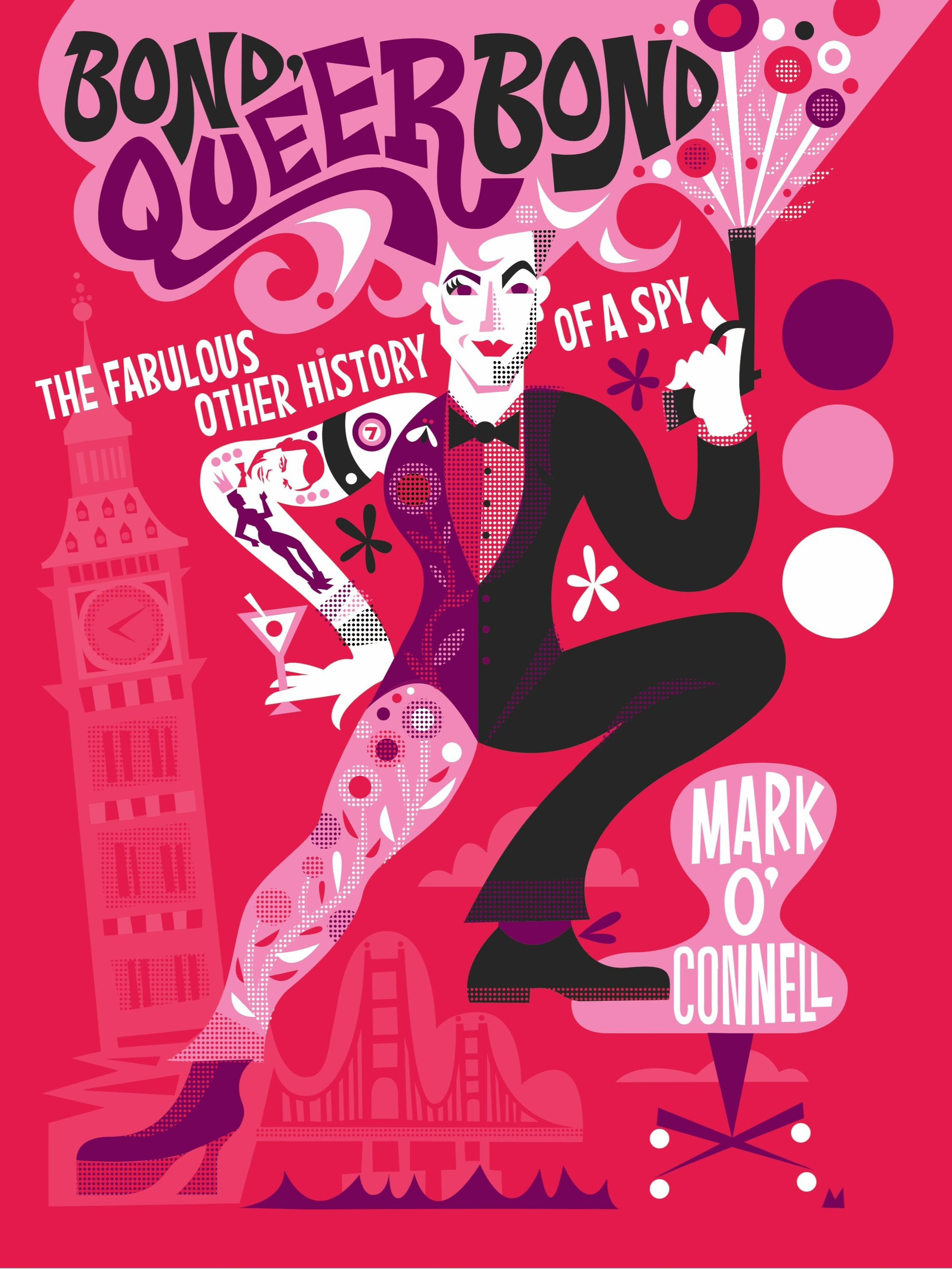
Mark O’Connell is a Polari Prize shortlisted author, writer and James Bond fan. His first book Catching Bullets – Memoirs of a Bond Fan (2012) positioned him as a global voice on all things Bond, VHS and gay. He is a pop culture advocate, news desk commentator and adopted child of San Francisco. His latest book Bond, Queer Bond – The Fabulous Other History of a Spy is published now by The History Press.

Tell us about your new book.
‘Well, hello there! My new publishing adventure is called Bond, Queer Bond – The Fabulous Other History of a Spy! It is a wholly original, unique and sometimes bold chronicle about the vital LGBTQ artistry, decisions and creativity that helped forge and steer the openly straight James Bond – onscreen, on the big screen and beyond. It has grown into a beautiful work that also features some vital Bond and gay names who really open out the discoveries and lost histories of 007 in often surprising and poignant ways. I wanted to do a new Bond book. But more importantly, I wanted to address how LGBTQ rights, progressions and publications are being thrown under various political buses for performative bigotries. There was suddenly no better knight of British culture than 007, and that felt like a good moment and filter to outline some lost queer histories – whilst surprise Bond fan folk with the real contexts to the properties and Bond tropes they hold dear. Ultimately, if a history is not complete because it has sidelined queer timelines and people, can it really then claim to be history?’
Who is your favourite writer and why?
‘As I journeyed through Bond, Queer Bond and discovered so much more about 007 creator Ian Fleming and his writer’s mind and mid-century pedestal, I could easily cite him on so many levels. However, a writer whose era, eye, voice and observations I continue to hold both vital and dear is Armistead Maupin.
As a gay teen I emerged into the mid 1990s seeing a UK press framing homosexuals with such performative bigotry. I would have the footage of dying angels in AIDS wards abandoned by their families or a brave lone mum clutching onto emaciated bedside hope as my only LGBTQ representation. We didn’t have Heated Rivalry. We had terrifying TV info-warnings about AIDS and the dangers of unprotected sex with an iceberg. And then there is Maupin and Tales of the City.
Whilst the 1980s tsunami of HIV/AIDS was very pinned to San Francisco, here is an out gay voice detailing like a Castro Dickens all the communities, foibles, relationships, momentums and unabashed sexuality of gay life in San Francisco in the late 1970s. It was not about warnings. It was about conversations, cool people and life. The first couple of books and the subsequent TV adaptation were vital signifiers of a happy, out, sexual, complicated queer world. It created a fascination and a wholly personal relationship with San Francisco for me. I wanted to know about Harvey Milk, and those ’taches and those topless boot-cut denim boys flanking the late night TV documentaries I would sneak-watch in my bedroom at 1am via Channel Four.
And then when Bond, Queer Bond comes full circle with its San Francisco findings alongside real queer world iconography I felt a certain Maupin duty to get those personalities and histories correct. He always has such skill at depicting the gay condition across the generations now but makes it universal. And never angry.
‘Maupin’s writing is more than a document.
It is a mindful template for gay life in a straight world.’
One of my happiest life beats was walking with a coffee in hand through the Castro with my husband as we realised the man nursing his own latte on another pavement coffee bench was Armistead himself. And then three minutes later on the same sidewalk we pass Cleve Jones and that direct, passionate link to Harvey Milk and SF’s sense of queer fight and activism. Suddenly, the cute boys with their ’taches holding hands on the sidewalk was more about me than AIDS warnings and icebergs. I thank Maupin for giving me not only a gay Oz, but also a second home with a history I hold very dear. Maupin’s writing is more than a document. It is a mindful template for gay life in a straight world.’
What are the best and worst writing tips you’ve ever heard?
‘I remember when I was starting out as a screenwriter – and writing comedy, short and feature scripts and having some production success – that there is a pile of ‘how to’ books out there and vying for my attention, from ‘screenwriting gurus’ who only ever wrote an episode of Kojak but made a name for themselves as script legends for writing self-help screenwriting books but never scripts. I was so glad to be warned off them. It made me realise just writing a script or a scene and finishing it via my instinct and momentum was the only way.
The sole piece of advice that may have partly instigated my first book Catching Bullets – Memoir of a Bond Fan (2012) was a cliché, but wholly true – write what you know. We do not all write to meet deadlines and manuscript word counts. But if you write knowing what your unique selling point is and why only your voice is the one that can tell a story, create a character world or recount that beat of history, then the work has a better chance of holding greater resonance and quality. And reality.’
Which classic novel have you never got around to reading? And which one do you consider over-rated?
‘There are loads of unread glories! I am a terrible reader. It is always this time of early summer when I start thinking about the US and a vacation – which then makes me do my annual brain announcement of wanting to read and know more of the beat poets.
Tess of the D’Urbervilles held great fascination as a teen as we would holiday around Thomas Hardy’s Dorset. It is also a shopping list of grief and tragedy, but without Dickens’ sense of social commentary and that slight humour regarding poverty and bad luck. Hardy just piles on the PTSD, starves it, has it married off against its will in the next county, sees it lose a baby in some stream and then has everyone die young of consumption. Without any food. I rarely felt Hardy was one of the people he actually wrote about. At least Wuthering Heights gets a Kate Bush makeover.’
What’s your signature dinner party dish?
‘So, in recent years, and partly because I had to make use of a cute cake tier stand I whim-bought, I have become family known for my egg mayonnaise sandwich fingers and high teas! I have also accidentally and rather singlehandedly brought back the sherry trifle in recent times – which is basically just nursery food for toddlers – so I now get asked for my martini glass trifles and the ‘recipe’ at a dinner soiree. Suddenly, my Roger Moore fandom makes total late 1970s sense when it comes to my signature dish… a boozy trifle and egg mayo sarnies.’
If you could invite five people living or dead to a dinner party, who would you invite and why?
‘It all depends on if they are cool with sherry trifle! Gosh, this is a list that forever changes. Okay, in no order of rank or brilliance… Kathy Burke – because of her intelligence, humanity and attitude, the gay politician and rights icon. Harvey Milk – because he accidentally made a pasty assed boy from Surrey, England fall in love with a gay village and community of communities and knew how to bring disparate souls together to many a table. Paul O’Grady – who I may well have had future dinner party seating luck as we had great mutual pals who miss him dearly, but who once beguiled me at a lock-in at the Royal Vauxhall Tavern and I always wanted to host him for dinner and lap up more of his devil does not care brilliance. The screenwriter Tom Mankiewicz – who had the best eye and ear for making hard script concepts like Bond and Superman totally work, and Bond author Ian Fleming – just so I can seat him amongst the others and watch them all collectively marvel at the martini trifles and tales of old Vauxhall and the tenderloin.’
What keeps you awake at night?
‘I had to realise recently that the rise of right-wing bigotry and fascism during a recent local election cycle did get me concerned. And the concern usually hit me in the early hours when I would get anxious that any conversation I was having about it would always be met with ‘it is just politics, you need to not worry’. But it is not my politics. Oh that it could just be that. It is my rights, my equalities, my social standing and my community. Jonathan Harvey says LGBTQ folk are always the canary in the mine. And I feel that in a world of more renewable energy and less fossil fuel, the gay fight has still to get into the coal mines and defend ourselves in the dark to those that have never had to ever think their lives are less ring-fenced or safeguarded than mine. I sometimes get asked ‘now that you have A, B and C, what is the next thing gay folk need to be mindful of and fight against?’ I always, always say… complacency.’
Tell us a joke OR tell us a secret.
‘I am currently loving the gay comic Matteo Lane so would only steal from him right now. Okay, this will sound like a book plug, but one of the great and somewhat sexy finds of my research journey on Bond, Queer Bond was that the gay porn world was always way ahead of the pop-culture curve. There is a whole collection of very underground, very vintage and very hirsute gay porn titles that steal from Bond, steal the existing soundtracks and have their own guns and dicks title sequences. And no one quite knows about them. Yet. Maybe Ian Fleming would be okay if we ended our dinner party night watching some! I would certainly kill to hear the other guests all start a running commentary together.’
Bond, Queer Bond – The Fabulous Other History of a Spy is published by The History Press